Undergraduate programs
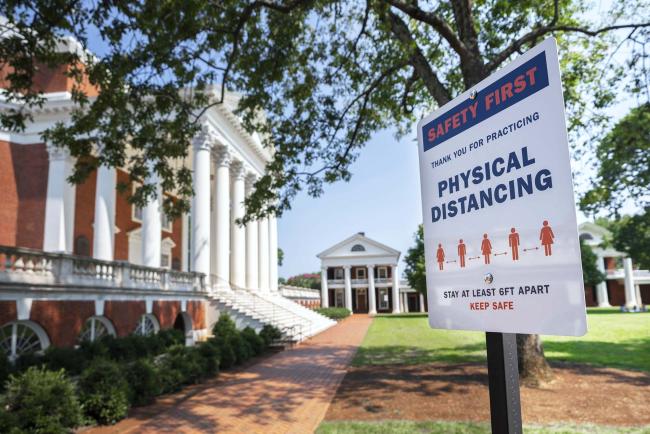
In March 2020, the COVID-19 pandemic upended all facets of society, and its impact was felt deeply at colleges and universities across the country.
On March 11, all UVA classes moved online, with students encouraged to return home and President Jim Ryan informing the University community that “we will not be holding classes on Grounds for the foreseeable future.”
Like the rest of the world, the School of Data Science, which was not even six months old when the shutdown began, would suddenly be forced to make dramatic adjustments.
“Phil often said during that time, ‘Building a new school is hard; building a different kind of school is harder; building a different kind of school in the middle of a pandemic is damn near impossible,'” recalled Arlyn Burgess.
Burgess added, though, that the School, despite its youth, was well positioned to weather this unprecedented disruption.
“We had a huge number of resources at our disposal, and also, data science became so important so fast in the pandemic itself,” she said, citing interest in network models and predictive analytics to track the spread of the disease.
Additionally, the School’s recent creation of an online master’s program proved even more beneficial than could have been imagined when it was conceived.
“All the residential students went into that online program,” said Phil Bourne. “So the teaching part was affected, but not as affected as badly as it could have been.”
Still, for a school that was in its infancy, particularly one whose aim was to foster collaboration, the pandemic created unavoidable challenges.
“It’s very much dependent on how people are personally interacting all day, every day,” said Bourne of the conditions needed to create the culture the School was aiming for. “And when you lose that, and everybody’s just in a Zoom window, it really affects things. When I look back on it, I’m actually surprised we did as well as we did.”
For students like Melissa Phillips, it was not the conclusion to her one-year master’s degree experience that she imagined or desired.
“It was challenging and not the way we wanted to end things because we really wanted to have that graduation moment,” she said.
Nevertheless, she credited the School for how it handled an incredibly difficult period.
“I feel like the transition was easier because of all the support we got from faculty and staff,” Phillips said.
Even though it was far from a traditional commencement, Burgess did fondly recall the poignant video remarks Bourne recorded on the steps of the Rotunda to honor the first group of master’s students to graduate since the School of Data Science had been established the year before.
Burgess remembered the moving scene and the look in Bourne’s eyes during his remarks and what she knew it signified: “The people that are getting those degrees are the future of what data science is going to be.”

With the grand opening of its new building in April 2024, and faculty and staff moved in by that summer, the School of Data Science began a new era heading into the 2024-25 academic year.
“We had a physical presence. I can’t overemphasize how important that was to the establishment of the School,” Dean Phil Bourne said in late 2025.
Along with its new space came new academic milestones, including the first graduates from the School’s doctoral program being hooded in May 2024: Kevin Lin, Saurav Sengupta, and Jiahao Tian.
“Because of the research and writing of Jiahao, of Saurav, of Kevin, someone, somewhere, sometime in the future will collect and analyze data, and they will do it differently because of the work of these students,” said professor Thomas Stewart, director of the Ph.D. program, at the diploma ceremony that spring.
Meanwhile, the master’s program, which had been a cornerstone of data science education at UVA for the preceding decade, was set to be retooled for the evolving times. The changes, announced in fall of 2024 for students matriculating the following year, included adjustments to modernize coursework and a move in the program’s start term from summer to fall.
“You can only do so much by changing the content in the classes to keep things up to date," said Jeffrey Blume, quantitative foundation associate dean for academic and faculty affairs in data science. "You’re still limited by the structure with which you originally organized the program, and that’s what we found we needed to change.”
The School also announced in fall 2024 the creation of a new genomics focus, available to students beginning in 2025, as part of the residential master’s program, thanks to an award from the National Institutes of Health.
Capping off a year marked by expansion and evolution was the announcement in December that Jaffray Woodriff and the Quantitative Foundation were making another sizable donation to UVA to support data science, this time for the construction of an additional building for the School.
“The second building is going to be much more intense with respect to research,” Bourne said. “It’s the next phase of data science,” he added.
In addition to its support of interdisciplinary research, long the beating heart of data science at UVA, the new building will aim to foster entrepreneurial efforts, with the goal of serving not only School of Data Science students but the broader University and community.
“I think that's part of this notion of the future of higher education, at least in my mind, where there are going to be startups, there are going to be entrepreneurs in residence,” Bourne said.
In March 2026, UVA’s Board of Visitors granted initial approval for design of the project, with the new five-story building being connected to the current data science home by an upper-level bridge.
Throughout 2024, the School of Data Science personnel ranks also continued to grow, with three new faculty — Chirag Agarwal, Mai Dahshan, and Nur Yildirim — joining in August and 11 staff members hired across the year. In 2025, the School hired nine new faculty and a dozen more staff to join the growing team.
As he saw the School grow from fewer than 30 employees in its early days to well over 100, Bourne reflected on what impact this could have on the workings and ethos of the School.
This expansion, Bourne said, had both increased research possibilities and eased burdens on previously stretched faculty and staff.
“The emphasis on research is getting even greater as our programs settle in. … The way we started was to actually hire faculty who could teach to fill the educational programs. We now have a bench,” he said, adding that in addition to teaching capabilities, the School was able to focus on the research directions prospective faculty hires would take.
Noting that most professors and employees gravitated to the School of Data Science because of its innovative spirit, Bourne said he wasn’t concerned that the School’s continued growth would compromise its guiding principles of openness, transparency, and interdisciplinarity.
“There is this notion, of course, that as you get bigger, you become more traditional, you fall into old ways. But I think there's a lot of enthusiasm in the School for not doing that. I remain pretty encouraged about where we're headed,” he said.

Another momentous day at the School of Data Science occurred on Aug. 26, 2024, when the inaugural class of data science undergraduate majors arrived at the School’s brand new home for orientation.
The three-year program had been approved less than a year earlier by the State Council of Higher Education for Virginia.
Dean Phil Bourne delivered introductory remarks, highlighting the critical role the 75 second-year UVA data science majors would play in the life and development of the first data science school in the nation.
“We don't want to be the first at being it. We want to be the first at it and be the best. No pressure on you, but that's only going to happen when you perform here, when you perform in your careers going forward,” he said.
With the arrival of the bachelor’s program, the School of Data Science now boasted a full complement of degree programs: an online and residential master’s program; a doctoral program; and an undergraduate major and minor.
The first undergraduate class, which will graduate in 2027, was followed the next year by an even larger cohort of 125 students, with students from across the country and globe.
Just weeks after the first data science majors began their journeys came the announcement that Scott and Beth Stephenson, longtime UVA supporters whose $3 million gift in 2021 led to the establishment of the Stephenson Dean at the School, were donating $10 million to help undergraduates pursuing a bachelor’s degree in data science. Their gift was matched by the University’s Bicentennial Scholars Fund.
Among other benefits, the program would provide 100% support for each Stephenson Scholar’s demonstrated financial need.
“I cannot think of a better way forward, nor better advocates of data science, than the Stephensons. The financial support and mentoring of the Stephenson Scholars will bring forth qualities of leadership in quantitative skills as applied to the needs of society,” Bourne said in a statement when the scholarship was announced.
In a 2024 interview, Scott Stephenson, who has served on the advisory board since 2015 when the School was still the Data Science Institute, explained why he was so excited about the possibilities of the undergraduate program, not only for UVA but for the commonwealth as a whole.
“Imagine if there is a high degree of retention of these bright graduates in the commonwealth of Virginia over an extended period of time, what they will do in terms of new business formation and contributing to the acceleration of preexisting businesses,” he said.
Among the first group of Stephenson Scholars when it was launched in the 2025-26 school year was Huda Mohmand of Woodbridge, Virginia, who is originally from Afghanistan.
“I hope the support as one of the first Stephenson Scholars shapes my journey in data science by allowing me to meet my goals towards improving the world, specifically my own country, Afghanistan, more easily and efficiently,” Mohmand said.
At the inaugural orientation, near the end of his remarks, Bourne emphasized the noble charge that he hoped data science graduates from all backgrounds, regardless of their career goals, would take with them from UVA.
“You're going to become leaders in analytic skills. And this is an institution that's renowned for leadership, and I have no doubts with the faculty you have here that you will become leaders in academic skills. But I want you to think about how you use those skills really to promote data science for the public good and the societal benefit,” he said.