Ph.D. program
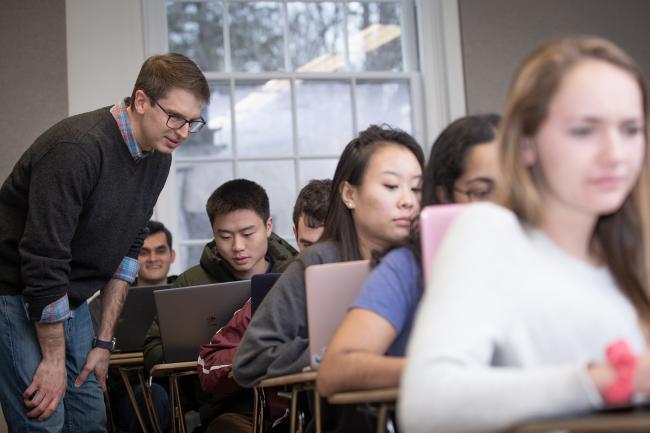
As the School grew, so too would its academic programs. The School of Data Science would achieve another milestone in this area in 2022 with the approval of a doctoral program.
In a release announcing the new program, Ian Baucom, the University’s provost, underscored what this development meant for the field itself: “Creating a Ph.D. in data science at UVA is another step toward using data to solve global problems.”
The full-time, residential program kicked off in August. Thomas Stewart, an associate professor who would join the faculty that fall, would eventually take the helm as program director.
In a video promoting the new Ph.D., Jeffrey Blume, associate dean of academic affairs, described what would distinguish UVA’s degree from others affiliated with data science but focused on statistics or computer science or some other related discipline.
“What makes our program unique is that we’re all in on data science,” Blume said. “We view ourselves as growing the next generation of data scientists.
In a year-end blog post, Phil Bourne reflected on this momentous moment.
“Our new Ph.D. in data science launched this academic year with 16 diverse students, all risk takers who have entrusted us with their careers,” he wrote. “We will not let them down.”
With the doctoral program approved, residential and online master’s degree offerings, and a very popular minor — which began in 2020 — all established, the School of Data Science lacked only one critical degree option to complete a full suite of academic programs: an undergraduate major.
In 2023 that moment would come. The State Council of Higher Education for Virginia in September approved a data science major. Current first-year students in the 2023-24 academic year would be eligible to apply that spring to join the program’s first cohort in fall 2024.
Describing the new major, Brian Wright, an associate professor of data science and director of the School’s undergraduate programs, said: “We’ve designed and are going to deploy a curriculum that is not seen anywhere else in the country.”
As for interest in the new major among students, there was little concern about that. The data science minor had become the most popular minor at the University, with more than 740 students enrolled from more than 50 majors by 2024, and the enrollment number continues to climb.
“It will be a popular major based on the demand that you’ve seen already from students,” said University President Jim Ryan.
Ryan also noted that the new undergraduate program would help further the University’s mission of serving Virginia and society.
“My hope is that not only will it enable students to be prepared to pursue a host of careers that we didn’t even imagine a decade ago, but also that we will prepare them to make a genuine contribution,” he said.

With the grand opening of its new building in April 2024, and faculty and staff moved in by that summer, the School of Data Science began a new era heading into the 2024-25 academic year.
“We had a physical presence. I can’t overemphasize how important that was to the establishment of the School,” Dean Phil Bourne said in late 2025.
Along with its new space came new academic milestones, including the first graduates from the School’s doctoral program being hooded in May 2024: Kevin Lin, Saurav Sengupta, and Jiahao Tian.
“Because of the research and writing of Jiahao, of Saurav, of Kevin, someone, somewhere, sometime in the future will collect and analyze data, and they will do it differently because of the work of these students,” said professor Thomas Stewart, director of the Ph.D. program, at the diploma ceremony that spring.
Meanwhile, the master’s program, which had been a cornerstone of data science education at UVA for the preceding decade, was set to be retooled for the evolving times. The changes, announced in fall of 2024 for students matriculating the following year, included adjustments to modernize coursework and a move in the program’s start term from summer to fall.
“You can only do so much by changing the content in the classes to keep things up to date," said Jeffrey Blume, quantitative foundation associate dean for academic and faculty affairs in data science. "You’re still limited by the structure with which you originally organized the program, and that’s what we found we needed to change.”
The School also announced in fall 2024 the creation of a new genomics focus, available to students beginning in 2025, as part of the residential master’s program, thanks to an award from the National Institutes of Health.
Capping off a year marked by expansion and evolution was the announcement in December that Jaffray Woodriff and the Quantitative Foundation were making another sizable donation to UVA to support data science, this time for the construction of an additional building for the School.
“The second building is going to be much more intense with respect to research,” Bourne said. “It’s the next phase of data science,” he added.
In addition to its support of interdisciplinary research, long the beating heart of data science at UVA, the new building will aim to foster entrepreneurial efforts, with the goal of serving not only School of Data Science students but the broader University and community.
“I think that's part of this notion of the future of higher education, at least in my mind, where there are going to be startups, there are going to be entrepreneurs in residence,” Bourne said.
In March 2026, UVA’s Board of Visitors granted initial approval for design of the project, with the new five-story building being connected to the current data science home by an upper-level bridge.
Throughout 2024, the School of Data Science personnel ranks also continued to grow, with three new faculty — Chirag Agarwal, Mai Dahshan, and Nur Yildirim — joining in August and 11 staff members hired across the year. In 2025, the School hired nine new faculty and a dozen more staff to join the growing team.
As he saw the School grow from fewer than 30 employees in its early days to well over 100, Bourne reflected on what impact this could have on the workings and ethos of the School.
This expansion, Bourne said, had both increased research possibilities and eased burdens on previously stretched faculty and staff.
“The emphasis on research is getting even greater as our programs settle in. … The way we started was to actually hire faculty who could teach to fill the educational programs. We now have a bench,” he said, adding that in addition to teaching capabilities, the School was able to focus on the research directions prospective faculty hires would take.
Noting that most professors and employees gravitated to the School of Data Science because of its innovative spirit, Bourne said he wasn’t concerned that the School’s continued growth would compromise its guiding principles of openness, transparency, and interdisciplinarity.
“There is this notion, of course, that as you get bigger, you become more traditional, you fall into old ways. But I think there's a lot of enthusiasm in the School for not doing that. I remain pretty encouraged about where we're headed,” he said.